
In this blog, Evidence and Evaluation Officer Kecia Painuthara shares more about why we developed our new Outcomes Framework and Measures Database, and how this will make a difference to our work moving forwards.
Babies, children, and young people deserve support that genuinely improves their lives. Finding out which services or support models ‘work’ is therefore crucial and why our work focuses on conducting and making the case for high quality evaluation.
Evaluation helps us understand whether services are making positive changes to children and families’ lives. These changes or ‘outcomes’ provide tangible indications of success which can be measured by a range of tools such as surveys, interviews, or information collected by services.
Choosing the right outcomes and measurement tools is important to accurately understand the difference a service makes. At Foundations, we work with our delivery partners (who have expertise delivering a service), and our evaluation partners (who have the technical expertise about how change should be measured) to make these decisions.
Clarity about the child and family level outcomes that matter most and how they should be measured helps us to generate consistent, comparable evidence that can inform decisions about services. In some areas of our work, the lack of a standard set of outcomes or measurement tools is a major barrier to the evaluation of services. For example, both our two pilot RCTs of recovery services for children affected by domestic abuse encountered challenges in identifying measurement tools that were validated, acceptable, and accessible for participating children and families. We are working to overcome these issues by funding the University of Sussex to identify and validate outcome measurement tools for the domestic abuse context, working alongside victim survivors.
Why we have developed an Outcomes Framework and Measures Database
We want to ensure that the evaluations we fund focus on key outcomes for vulnerable children who are most affected by family-level risks. These outcomes need to reflect the evidence base and what matters to children and families themselves, local commissioners, and national policy makers. If we measure outcomes that are not important to these groups or use tools that are not accurate, comparable, or reliable, it is less likely that evaluation results will influence services or policy.
Getting this right is fundamental to the success of our work and so we have been developing our own outcomes framework and measures database with a consortium comprising Oxford MeasurEd, The Brilliant Club, and the Association for Young People’s health. The consortium have been helping us to clarify and define the child and parent/caregiver outcomes that we will measure in our work. Our Outcomes Framework and Measures Database will be a resource for all our evaluations going forward and we will regularly update these resources to ensure they continue to be relevant and useful for our partners.
What does our Outcomes Framework and Measures Database include?
Foundations’ Outcomes Framework describes the 10 measurable outcomes relevant to our strategy and aligned with the Children’s Social Care National Framework. Focusing our evaluations on these 10 outcomes helps show progress towards the four most important things to achieve our mission and Department for Education priorities as part of the children’s social care reforms:
- Children and young people are supported by their family to develop and thrive
- Children and young people are safe in their homes
- Children, young people and families staying together as much as is safely possible
- Children in care and care leavers have stable, loving relationships
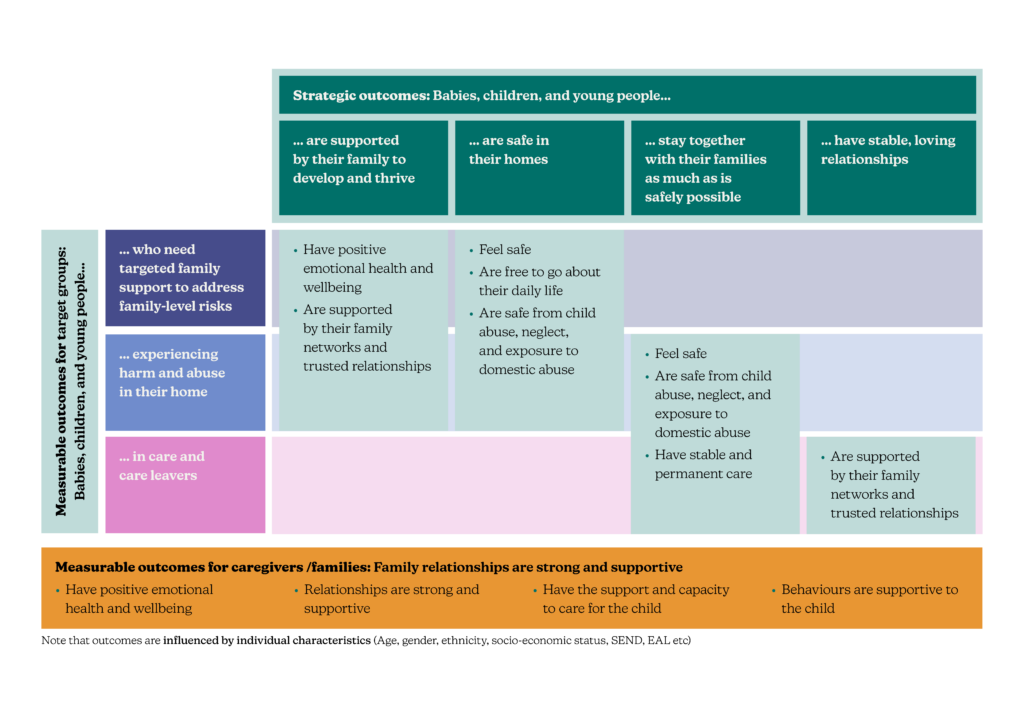
These 10 outcomes were identified and defined through a process that included reviewing the literature and consulting with a range of stakeholders including children and young people. The measures database lists over 200 tools that help to measure these outcomes. The database also includes practical and statistical information about the validity and reliability of available tools. We want to make sure we are accurately measuring the outcomes we intend to capture. This will also help us easily compare the impact of different services over time.
Our framework reflects Foundations’ specific focus on children who need targeted support to address family level risks. This is not comprehensive; we know our framework does not include other outcomes that are also important to children and families and our overall mission, like broader health and education outcomes. Our outcomes framework is intended to sit alongside and complement the work of other organisations who also aim to support positive outcomes for children and families.
How does Foundations’ Outcomes Framework differ from other frameworks?
We’re not alone in our efforts to harmonise outcomes measurement and where relevant we have aligned our work with that of others like the Common Outcomes Framework for Children and Families and the Domestic Abuse Core Outcome Set. To develop our framework, we consulted the Common Outcomes for Children and Young People Collaborative, University College London, the University of Sussex, What Works Centres, and other mission-aligned organisations.
What difference will Foundations’ Outcomes Framework and Measures Database make?
We have developed these resources to ensure the evaluations we commission are focused on a common set of measurable outcomes. This work will inform our commissioning decisions, support our partners to select the right measurement tools, and provide a helpful starting point for delivery partners and evaluators who submit applications for our funding calls.
Our measures database may also be useful to other organisations who are involved in evaluating services for children affected by family level risks or who are care experienced. More standardisation and consistency in outcomes measurement will strengthen the evidence available to inform both policy and commissioning decisions locally.
By focusing our evaluations on the outcomes that matter most to children and their families we will use our framework and database to help us achieve our vision and mission: to ensure vulnerable children have the relationships they need to thrive.
Read our recently published report to find out more about how our outcomes framework and measures database were developed and how it will be used.