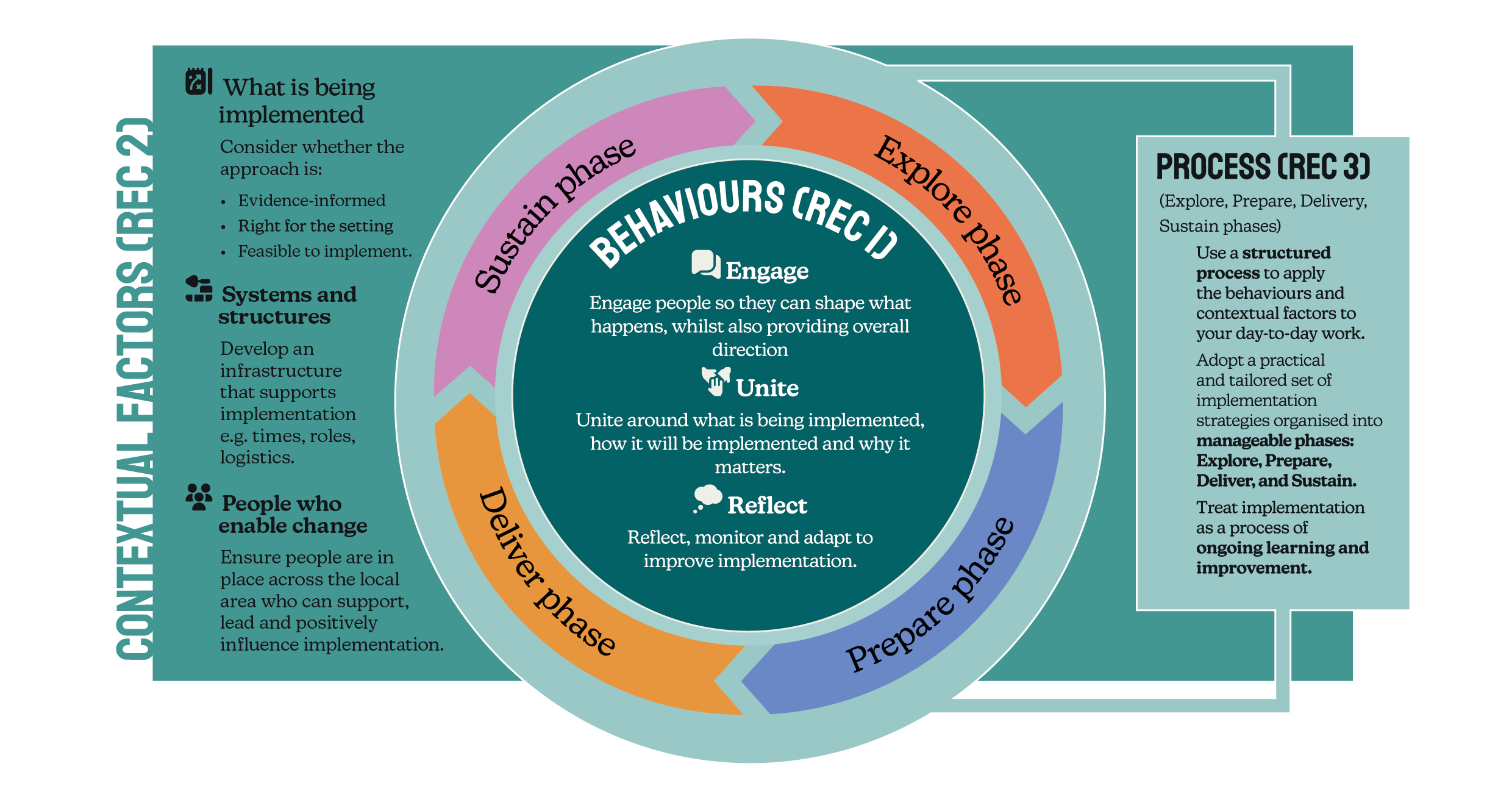
This implementation framework aims to acknowledge the complexities facing local authorities while offering a structure for integrating evidence into local systems that support children and families. The framework is structured around different factors:
Each part of this framework works together. This structure helps local areas to implement evidence-based approaches in services for children and families effectively. The behaviours and contextual factors underpin effective implementation and should infuse day-to-day work. The process helps navigate change and organise implementation into manageable phases: Explore, Prepare, Deliver, and Sustain.
The framework is based on an extensive review of evidence on implementation originally completed by the Education Endowment Foundation for use in schools. This has been supplemented by an umbrella review and evidence synthesis of barriers and facilitators to implementing children’s services to further contextualise this document.
Developed in collaboration by the City of York Council and Foundations, with support by a Research Fellow funded by the National Institute of Health and Social Care Research and adapted from A School’s Guide to Implementation, originally developed by the Education Endowment Foundation (EFF).
This is currently a beta version of the framework, which has been developed in the first instance for testing in collaborating local areas. A final version with updated references will be available in due course.

This guide aims to acknowledge the complexities facing local authorities while offering a structured framework for integrating evidence into local systems that support children and families.
The framework is structured into three parts (recommendations), with each recommendation focusing on a different factor: behaviours that drive implementation; contextual factors that influence implementation; and the implementation process.
Each part of this framework works together. This structure helps local areas to implement evidence-based approaches in services for children and families effectively. The behaviours and contextual factors underpin effective implementation and should infuse day-to-day work. The process helps navigate change and organise implementation into manageable phases: Explore, Prepare, Deliver, and Sustain.
This framework has been designed for leaders working in Local Authority Children’s Services and partnering organisations, who have responsibility for managing change. This includes Directors and Assistant Directors; Heads of Service; and Team Leaders. The guidance also highlights the vital role of the range of people who are involved in leading implementation; acknowledging the fact that successful implementation is a collective, team endeavour and does not come down to any one individual.
Recommendation 1: Adopt behaviours that drive implementationMay 15, 2025
March 17, 2025
Receive the latest news, events and research from Foundations.
You can unsubscribe at any time by clicking the link in the footer of our emails. For information on how we process your personal data please review our privacy policy.
Rated 1: Set up and delivery is low cost, equivalent to an estimated unit cost of less than £100.
Rated 2: Set up and delivery is medium-low cost, equivalent to an estimated unit cost of £100–£499.
Rated 3: Set up and delivery is medium cost, equivalent to an estimated unit cost of £500–£999.
Rated 4: Set up and delivery is medium-high cost, equivalent to an estimated unit cost of £1,000–£2,000.
Rating 5: Set up and delivery is high cost. Equivalent to an estimated unit cost of more than £2,000.
Set up and delivery cost is not applicable, not available, or has not been calculated.
Click here for more information.
Lorem ipsum dolor sit amet, consectetuer adipiscing elit. Aenean commodo ligula eget dolor. Aenean massa. Cum sociis natoque penatibus et magnis dis parturient montes, nascetur ridiculus mus.
Supporting children’s mental health and wellbeing: Lorem ipsum dolor sit amet, consectetuer adipiscing elit. Aenean commodo ligula eget dolor. Aenean massa. Cum sociis natoque penatibus et magnis dis parturient.
Preventing child maltreatment: Lorem ipsum dolor sit amet, consectetuer adipiscing elit. Aenean commodo ligula eget dolor. Aenean massa. Cum sociis natoque penatibus et magnis dis parturient.
Enhancing school achievement & employment: Lorem ipsum dolor sit amet, consectetuer adipiscing elit. Aenean commodo ligula eget dolor. Aenean massa. Cum sociis natoque penatibus et magnis dis parturient.
Preventing crime, violence and antisocial behaviour: Lorem ipsum dolor sit amet, consectetuer adipiscing elit. Aenean commodo ligula eget dolor. Aenean massa. Cum sociis natoque penatibus et magnis dis parturient.
Preventing substance abuse: Lorem ipsum dolor sit amet, consectetuer adipiscing elit. Aenean commodo ligula eget dolor. Aenean massa. Cum sociis natoque penatibus et magnis dis parturient.
Preventing risky sexual behaviour & teen pregnancy: Lorem ipsum dolor sit amet, consectetuer adipiscing elit. Aenean commodo ligula eget dolor. Aenean massa. Cum sociis natoque penatibus et magnis dis parturient.
Preventing obesity and promoting healthy physical development: Lorem ipsum dolor sit amet, consectetuer adipiscing elit. Aenean commodo ligula eget dolor. Aenean massa. Cum sociis natoque penatibus et magnis dis parturient.
Rated 2: Has preliminary evidence of improving a child outcome from a quantitative impact study, but there is not yet evidence of causal impact.
Rated 2+: Meets the level 2 rating and the best available evidence is based on a study which is more rigorous than a level 2 standard but does not meet the level 3 standard.
Rated 3: Has evidence of a short-term positive impact from at least one rigorous study.
Rated 3+: Meets the level 3 rating and has evidence from other studies with a comparison group at level 2 or higher.
Rated 4: Has evidence of a long-term positive impact through at least two rigorous studies.
Rated 4+: Meets the level 4 rating and has at least a third study contributing to the Level 4 rating, with at least one of the studies conducted independently of the intervention provider.
Rating has a *: The evidence base includes mixed findings i.e., studies suggesting positive impact alongside studies, which on balance, indicate no effect or negative impact.
Click here for more information.