
The Guidebook provides information only about what we describe as interventions. Interventions are manualised (written down), well defined, repeatable activities.
We know that support for children and families takes other forms too – from a teacher, social worker or other frontline professional spotting the first signs of risk in a child or family, through to wholesale system changes across the agencies and services at work in a local area.
The Guidebook includes studies – which evaluate the impact of the different interventions – from the United Kingdom and internationally in countries with similar child and family welfare systems to the UK. Most studies in the Guidebook are based on research conducted in the US, Australia and the UK.
All the interventions on the Guidebook have the potential to be implemented in the UK, and have evidence that is relevant to the UK context. However, the Guidebook does include interventions that have not been implemented in the UK. One of the Guidebook’s goals is to identify promising interventions that could be potentially adapted to the UK context, even if they are not currently available here. Interventions are marked as ‘UK available’ where applicable.
The Guidebook aims to present information about race and ethnicity transparently and sensitively. It reflects how these characteristics are reported in the studies that underpin the evidence ratings and aligns with best practice on reporting and language.
Our approach aims to help Guidebook users to understand which children and families interventions have worked for, and where evidence may, or may not, be available for specific populations. It’s important to note that interventions may have been delivered and evaluated successfully with populations other than those listed; only those populations involved in the studies which underpin the Guidebook evidence rating are mentioned. Unless specified, the intervention may have been designed to be implemented with a wide variety of different communities.
Interventions added to the Guidebook from May 2026 include an Equality, Diversity, Inclusivity and Equity (EDIE) section. This presents a narrative EDIE summary, drawn from:
- The quantitative impact evidence about the intervention’s effects on specific populations or sub-groups and
- Qualitative evidence about the implementation of lived experience of children and families who are receiving the intervention.
In addition, model descriptions outline any design features which promote equity. This could include interventions developed by and for particular communities, or approaches that intentionally address access and inclusion for all communities.
Interventions with the potential to improve outcomes for children are selected for assessment and consideration for inclusion on the Guidebook through open calls to intervention providers, themed assessment rounds designed to support national and local priorities, and research by the Foundations team.
Guidebook assessments focus on impact evaluations, studies that help us understand whether an intervention has had a measurable, positive effect on child outcomes.
The Guidebook provides information only about interventions that have at least preliminary evidence of achieving positive outcomes for children, such as improving mental health, school attainment, or behaviour.
We do not include qualitative evidence in our assessments, because this type of evidence does not allow us to draw strong conclusions about whether an intervention has caused changes in outcomes. Qualitative evidence is useful for other purposes and is used to inform the key principles outlined in the Practice Guides which, alongside the Guidebook, make up our Toolkit.
Qualitative evidence is also used in the EDIE sections of new intervention entries added to the Guidebook from May 2026.
The evidence standards were initally developed in 2016 by the Early Intervention Foundation (EIF) with other What Works Centres to assess the impacts of interventions. They are broadly similar to the Maryland Scale and other relevant appraisal systems and were formally approved by a panel of external experts in the field of prevention science and child development.
In April 2026, we published a revised set of evidence standards for Guidebook Level 3 evidence rating. The revised evidence standards are more fully aligned with current best practice and those used in the Practice Guides, while at the same time being based on previous Guidebook standards.
These standards combine implementation guidance for Cochrane’s Risk of Bias tools, and a small set of additional criteria.
The implementation guidance makes Cochrane’s tools more specific and appropriate for evaluations in early intervention and children’s social care.
Previous Guidebook standards and the Title IV-E Prevention Services Clearinghouse standards also informed the development of the implementation guidance.
Overall, the standard for Level 3 has not substantially shifted up or down but small changes have been made to specific criteria. Level 2 and Level 4 standards remain unchanged. The updated standards were:
- Developed and tested internally
- Reviewed and tested for content validity by a range of external experts
- Piloted by one of Foundations’ evidence partners
- Peer reviewed by two expert reviewers.
You can find out more about the evidence standards in the Guidebook Handbook v 2.0 (2026).
The evidence rating tells you how much confidence we have that an intervention is the reason there has been an improvement in a child’s outcome/s.
To score interventions we use levels that range from 2 to 4+. The score indicates the strength of an intervention’s best evidence.
Sometimes, the studies that underpin an intervention’s evidence rating have mixed findings. These are indicated by an asterisk after the rating score (e.g. 3*).
You can find out more about how we rate interventions in the Guidebook Handbook v 2.0 (2026).
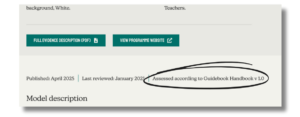
The relevant Handbook version is specified on each intervention page as shown in the image below.
Impact describes the size of the improvements that an intervention has produced. In other words, has it had a big impact or a small one? Impact is not the same as strength of evidence, which helps us to understand how confident we can be that the change is caused by the intervention.
The impact of interventions is captured in two ways:
- An improvement index is shown for some interventions with a rating of 3 or more, which captures the difference an intervention has made using a standardised measure. This enables you to compare improvements across interventions.
- The full evidence description for each intervention tells you the effect size of the improvement that an intervention has made to a child’s outcomes, drawn from the underpinning studies. This is available on each intervention page in the summary section, as a downloadable PDF.
The cost rating indicates an intervention’s relative cost compared to other interventions in the Guidebook.
It estimates how costly an intervention is per person receiving the intervention, based on the resources needed to set up and deliver it. For example, the time it takes, how many families it aims to reach, and any staff training required.
The estimated cost for each child, parent or family is rated on a scale from 1 to 5, where 1 indicates the least resource-intensive interventions, and 5 the most resource-intensive. The rating helps you to compare the likely costs of different interventions.
The cost rating does not represent what it will actually cost to buy or commission the service, which is negotiated between the provider and commissioner and can vary in practice.
From 2026 we will use an updated cost model to arrive at cost ratings. The revised model uses an economic modelling perspective, aiming to incorporate different cost components. You can find out more about how we rate interventions in the Guidebook Handbook v 2.0 (2026).
The Guidebook groups the strength of the evidence for interventions across seven major outcomes that we know improve the chances that a child can thrive:
- Supporting children’s mental health and wellbeing
- Preventing child maltreatment
- Enhancing school achievement and employment
- Preventing crime, violence and antisocial behaviour
- Preventing substance abuse
- Preventing risky sexual behaviour
- Preventing obesity and promoting physical healthy development.
These outcome groups help you compare evidence across different interventions using a consistent framework.
Underneath each major outcome, you can drill down to find lists of more specific outcomes. For example, under Enhancing School Achievement you can find the strength of evidence for improved early literacy, and under Supporting Children’s Mental Health and Wellbeing, you can see the strength of the evidence about children’s social and emotional development. This allows you to identify targeted interventions that match the needs of local children and families.
Foundations aims to continually improve the Guidebook. In April 2026, we published a new Guidebook Handbook v 2.0. This revised Handbook gives a clear and detailed overview of the whole intervention assessment process, and includes updates to some aspects, including:
- Guidelines on how the Guidebook handles adapted versions of interventions
- Updated evidence standards for Level 3: Promising interventions, which will be used to assess the evidence rating for new studies and interventions added to the Guidebook in the future
- An updated cost model which underpins cost ratings for new interventions added to the Guidebook from May 2026
- The commitment to equality, diversity, inclusion and equity integrated throughout the assessment process, and the new EDIE section on Guidebook entries.
In April 2026, we published Guidebook Handbook v 2.0, featuring improvements to Guidebook processes and standards. Additionally, the Technical Guide (published in May 2025) was renamed Guidebook Handbook v 1.0 for consistency.
Handbook v 1.0 reflects the processes and evidence standards established in 2016 by the Early Intervention Foundation (EIF) and used up until April 2026. Intervention entries added on the Guidebook before April 2026 have added information to specify that they were assessed against Guidebook Handbook V 1.0. New intervention entries added in the future will have information specifying that they are assessed against Handbook V 2.0.
We may release new versions of the Handbook in the future as we continue to improve the Guidebook.
The Guidebook is not a complete or exhaustive list. There are thousands of interventions and approaches with various levels of evidence, and we cannot include all of them. If you cannot find an intervention on the Guidebook, it may be that we have not yet assessed the evidence for it. As we conduct further assessment rounds we will continue to add more interventions to the Guidebook, as well as updating existing intervention ratings with the results of new evaluation studies.
Alternatively, we may have assessed the evidence for an intervention and given it a rating of NL2 (not yet level 2). A rating of NL2 does not necessarily mean that an intervention does not work. Many NL2 interventions are developing and innovating, with important foundational work being carried out on the way to becoming established and effective interventions. This might include developing a theory of change or logic model, or carrying out feasibility, implementation, or pilot evaluation studies. For a list of interventions that have been assessed as NL2 in the past, see Appendix 1 of Guidebook Handbook v 2.0.