
How to use the Guidebook

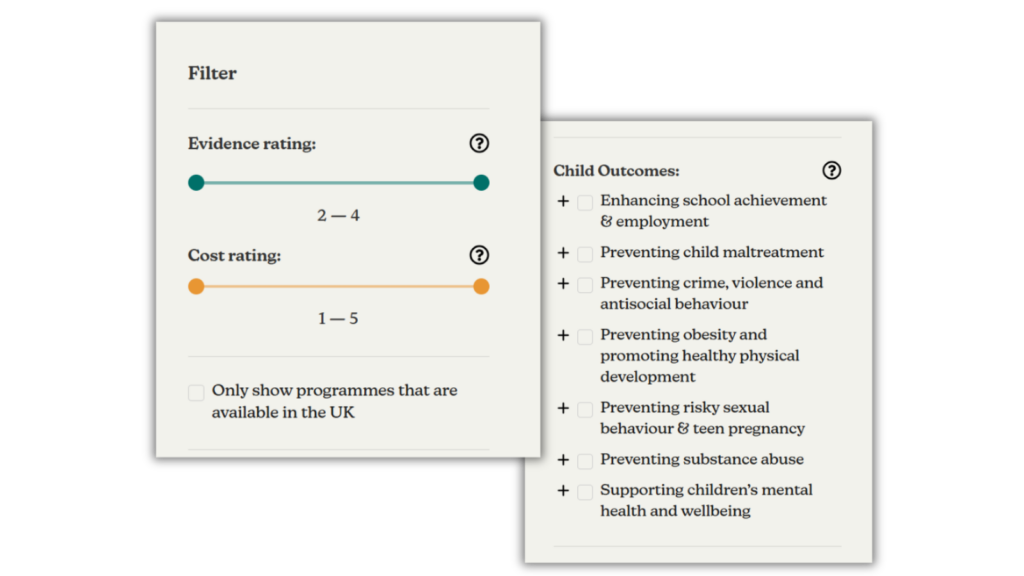
On the Guidebook’s listing page, you can filter interventions by evidence and cost ratings, and outcomes, to find options that suit the needs of children and families in your area.  
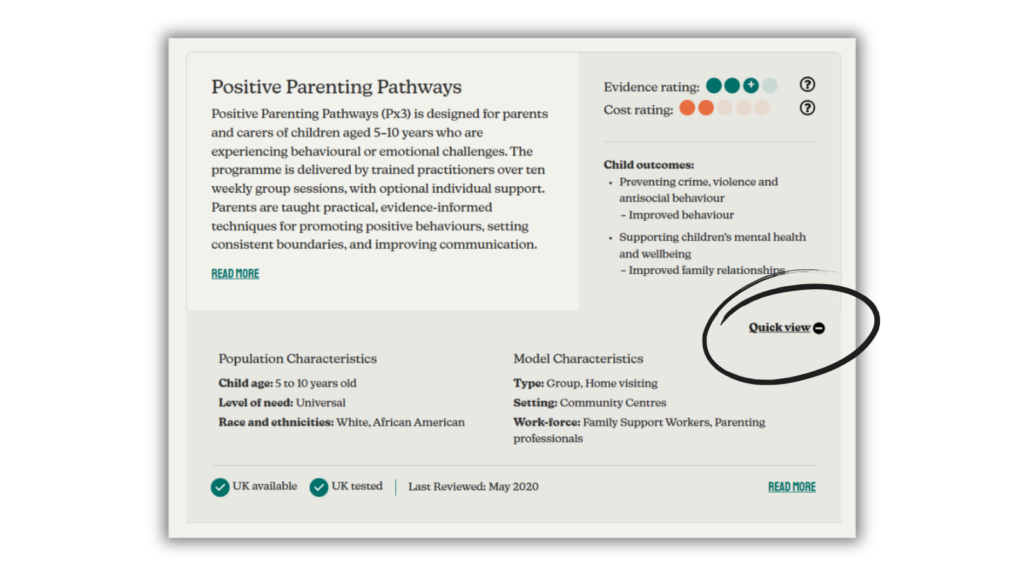
A summary of key information about each intervention is available at a glance, and you can also access a quick view for additional information.
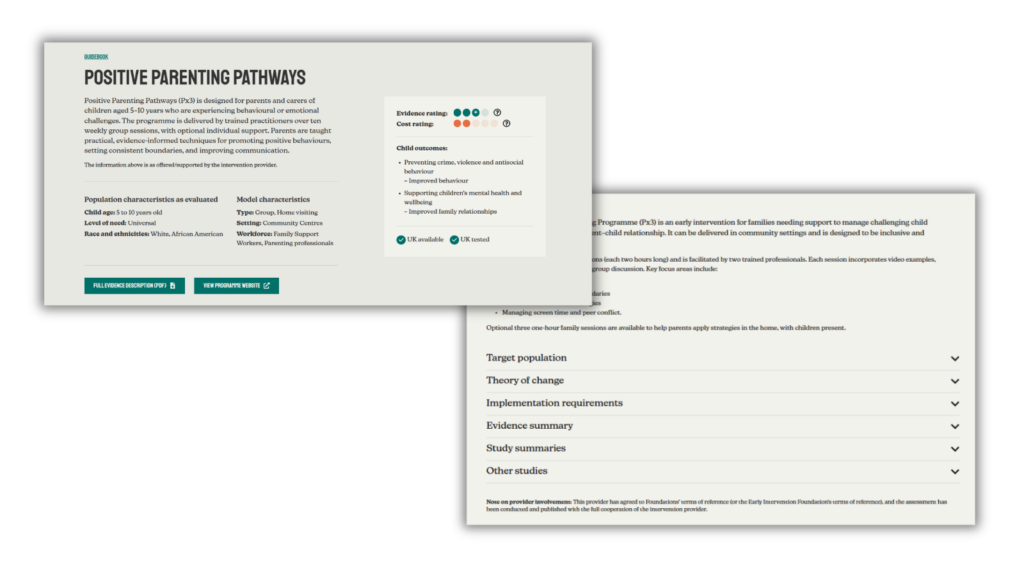
For full details about an intervention, click through to the intervention page, which is the main entry for each intervention. This includes the intervention’s theory of change, information on implementation and summaries of the individual studies on which the intervention’s evidence rating is based.
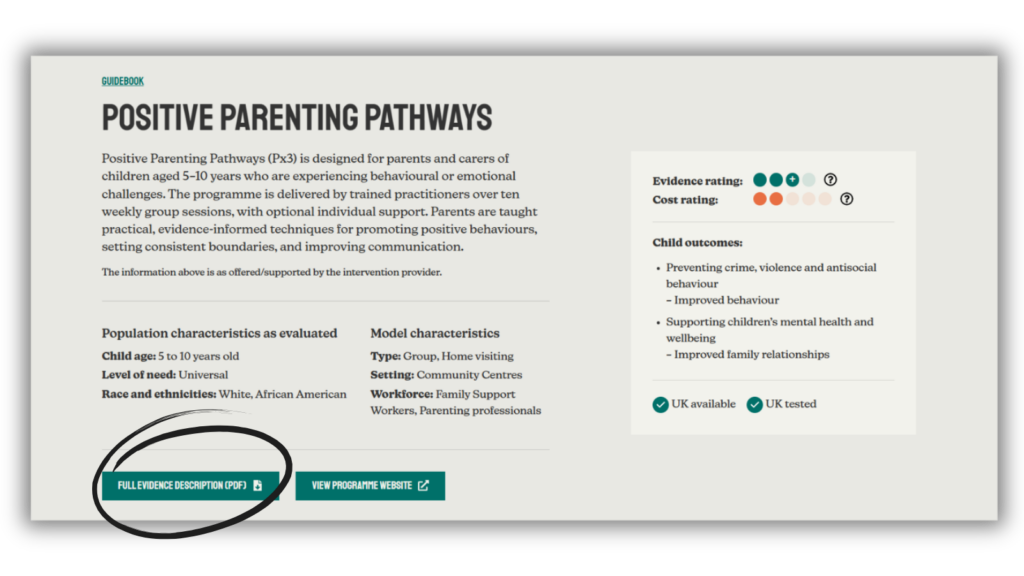
You will also find a full evidence description in PDF form on each intervention page, which includes all the information on the intervention that is on the webpage, plus detailed technical information about the underpinning studies.
The Guidebook has improved filtering too to make it quicker and easier for you to find the information that you need. The filter allows you to search by cost and evidence ratings, for interventions delivered in the UK, and by the seven major outcomes, as well as by advanced criteria such as participant age.

The search bar has a new ‘fuzzy’ tool which means that you don’t need to know exactly what you are looking for. The search will also still return results even if there are typos or spelling errors in the search term/s that you enter.


Summary of Foundations Guidebook updates
  • April 2026: Publication of the revised Guidebook Handbook v 2.0, which gives a clear and detailed overview of the whole intervention assessment process, and includes updates to some aspects. These include updated evidence standards for ‘Level 3: Promising interventions’; handling adapted versions of interventions; and how we are embedding EDIE throughout the assessment process, and in a new EDIE section on Guidebook intervention pages – for interventions added after May 2026.
  • May 2025: Foundations’ Guidebook is launched, with improved the search function so users can quickly get details about individual interventions. Most Guidebook entries remained the same as they were on the previous EIF Guidebook, with evidence and cost ratings, studies that underpin the evidence rating, and implementation information. We added new or improved features including: a full evidence description (in a downloadable PDF) with more detail about the studies underpinning the evidence rating; information on the ethnicity and race of children and families in the underpinning studies; more consistent reporting of parent outcomes that are in the underpinning studies that contribute to the evidence rating; more accessible and consistent language across the interventions about evidenced outcomes; a new, more transparent format for the theory of change for each intervention.

Cost ratings:

Rated 1: Set up and delivery is low cost, equivalent to an estimated unit cost of less than £100.

Rated 2: Set up and delivery is medium-low cost, equivalent to an estimated unit cost of £100–£499.

Rated 3: Set up and delivery is medium cost, equivalent to an estimated unit cost of £500–£999.

Rated 4: Set up and delivery is medium-high cost, equivalent to an estimated unit cost of £1,000–£2,000.

Rating 5: Set up and delivery is high cost. Equivalent to an estimated unit cost of more than £2,000.

Set up and delivery cost is not applicable, not available, or has not been calculated.

Click here for more information.

Child Outcomes:

Lorem ipsum dolor sit amet, consectetuer adipiscing elit. Aenean commodo ligula eget dolor. Aenean massa. Cum sociis natoque penatibus et magnis dis parturient montes, nascetur ridiculus mus.

Supporting children’s mental health and wellbeing: Lorem ipsum dolor sit amet, consectetuer adipiscing elit. Aenean commodo ligula eget dolor. Aenean massa. Cum sociis natoque penatibus et magnis dis parturient.

Preventing child maltreatment: Lorem ipsum dolor sit amet, consectetuer adipiscing elit. Aenean commodo ligula eget dolor. Aenean massa. Cum sociis natoque penatibus et magnis dis parturient.

Enhancing school achievement & employment: Lorem ipsum dolor sit amet, consectetuer adipiscing elit. Aenean commodo ligula eget dolor. Aenean massa. Cum sociis natoque penatibus et magnis dis parturient.

Preventing crime, violence and antisocial behaviour: Lorem ipsum dolor sit amet, consectetuer adipiscing elit. Aenean commodo ligula eget dolor. Aenean massa. Cum sociis natoque penatibus et magnis dis parturient.

Preventing substance abuse: Lorem ipsum dolor sit amet, consectetuer adipiscing elit. Aenean commodo ligula eget dolor. Aenean massa. Cum sociis natoque penatibus et magnis dis parturient.

Preventing risky sexual behaviour & teen pregnancy: Lorem ipsum dolor sit amet, consectetuer adipiscing elit. Aenean commodo ligula eget dolor. Aenean massa. Cum sociis natoque penatibus et magnis dis parturient.

Preventing obesity and promoting healthy physical development: Lorem ipsum dolor sit amet, consectetuer adipiscing elit. Aenean commodo ligula eget dolor. Aenean massa. Cum sociis natoque penatibus et magnis dis parturient.

Evidence ratings:

Rated 2: Has preliminary evidence of improving a child outcome from a quantitative impact study, but there is not yet evidence of causal impact.

Rated 2+: Meets the level 2 rating and the best available evidence is based on a study which is more rigorous than a level 2 standard but does not meet the level 3 standard.

Rated 3: Has evidence of a short-term positive impact from at least one rigorous study.

Rated 3+: Meets the level 3 rating and has evidence from other studies with a comparison group at level 2 or higher.

Rated 4: Has evidence of a long-term positive impact through at least two rigorous studies.

Rated 4+: Meets the level 4 rating and has at least a third study contributing to the Level 4 rating, with at least one of the studies conducted independently of the intervention provider.

Rating has a *: The evidence base includes mixed findings i.e., studies suggesting positive impact alongside studies, which on balance, indicate no effect or negative impact.

Click here for more information.